Don't Skip Your Hackathon Arc
At the start of a hackathon, every idea sounds possible. A few hours later, your team is negotiating which three quarters of it must disappear before the demo.
Somewhere between the broken API, cold pizza, and last minute pitch, you learn something ordinary side projects rarely teach: how to stop imagining and start shipping.
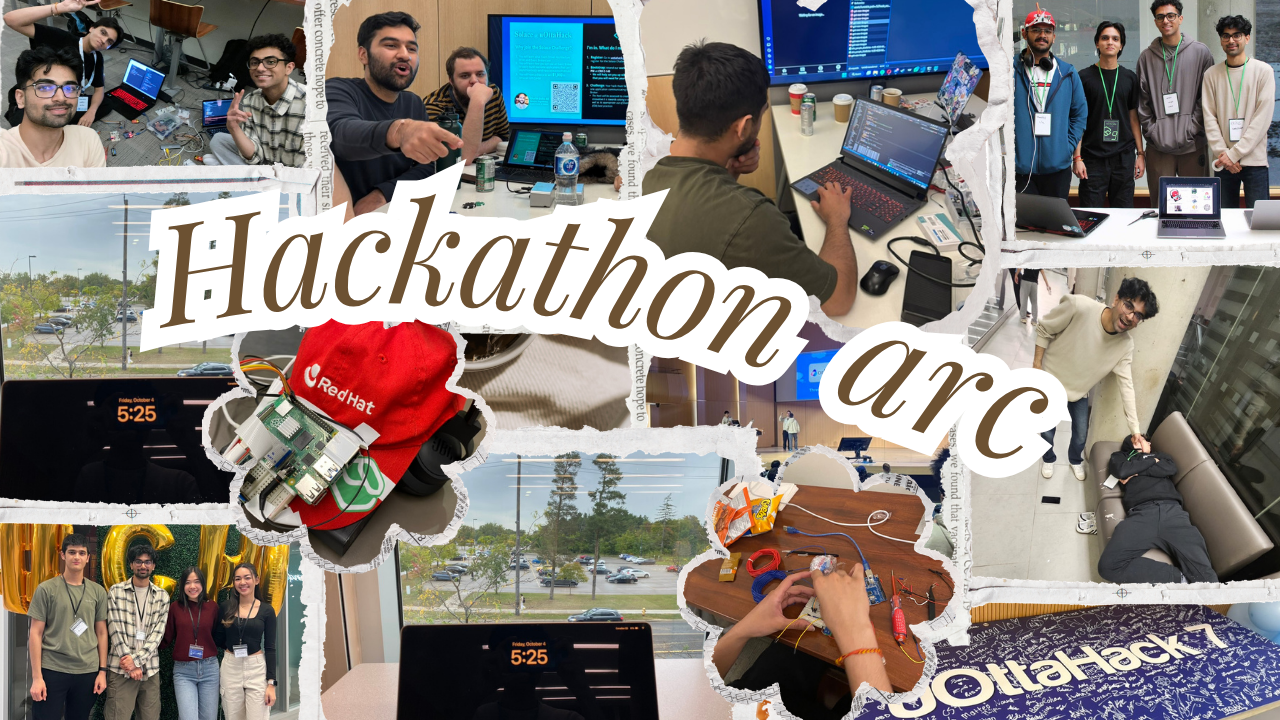
What even is a hackathon?
A hackathon is an event where a bunch of hackers get together to build something within 24 to 36 hours. Not hackers in the breaking into computers sense. At hackathons, that is simply what the participants are called.
During that time, you:
- Choose a problem.
- Form a team.
- Promise to build something “simple.”
- Accidentally design an entire startup.
- Remove 80% of the features.
- Somehow get a demo working.
- Pitch it to judges while praying nobody clicks the button that is purely decorative.
Some hackathons give you a specific problem. Others have themes like healthcare, finance, climate, or AI. Apparently, we cannot hold a tech event these days without putting AI somewhere in the title.
At the end, everyone presents what they built. Judges ask questions, winners get prizes, and you go home with a project called something like final_final_v2_WORKING.
Why Attend a Hackathon?
Hackathons are one of the fastest ways to learn what building a real product actually feels like.
-
You get the obvious perks. Hackathons usually come with free food, sponsor merch, and prizes worth competing for. You can also speak directly with recruiters and engineers. If you are looking for an internship, a real conversation is much better than sending another LinkedIn application and getting ghosted.
-
You learn to make decisions. On a personal project, you can spend an entire evening choosing a font. At a hackathon, the demo is tomorrow, authentication is broken, and someone needs to find out why the database disappeared. You have to decide which feature matters, what can be simplified, and what the demo actually needs.
-
You learn to compromise. Your team has to agree on a tech stack. You might convince everyone to use the framework you know best, or someone else might make a better case and send you into unfamiliar territory. Sometimes the answer is a compromise that nobody loves but everyone can work with. You learn how to explain your reasoning, listen when someone disagrees, and resolve conflict without making it personal.
-
You discover your strengths. Maybe you can build quickly. Maybe you are good at turning a messy idea into a clear plan. Maybe you are weirdly calm when everything catches fire. You also discover what you are bad at, which is slightly less fun but probably more useful.
-
You learn to ship. Most side projects die because there is always more time. At a hackathon, you have until Sunday afternoon. The deadline forces you to stop polishing the imaginary perfect version, reduce the scope, and build something that actually works. It might be held together with fixed demo data and emotional support, but it exists.
Meet People Naturally
I do not enjoy walking up to strangers and saying, “Hello, I would like to add you to my professional network.”
Thankfully, hackathons give you something better to talk about.
You are solving a problem together. You are debugging something at 2 a.m. You are trying to understand why the API documentation appears to be describing an entirely different API.
That creates real connections.
You quickly learn how someone communicates, handles pressure, shares ideas, and reacts when their code deletes everyone else’s work.
Some people leave hackathons with future cofounders, friends, job opportunities, or collaborators. At minimum, you leave knowing several people’s GitHub usernames and absolutely none of their last names.
Where do you find these things?
Devpost is usually the easiest place to start. It has online and in person hackathons covering almost every possible theme.
Students should also check Major League Hacking, which maintains a schedule of events for students.
For local hackathons, search Luma, Eventbrite, university clubs, company communities, and local developer groups. Toronto has a surprisingly active builder community if you are willing to dig through a few event calendars.
You can also ask at work. Internal hackathons are a great introduction because you already understand the company, know some of the people, and may even have access to functioning documentation. Luxury.
First Hackathon Advice
-
Your idea is too big. I have not heard it yet, but it is too big. Take the main feature and cut it in half. Then cut it in half again. Build one flow that makes people say, “Oh, I get it.”
-
Use boring technology. This is not the moment to learn a new frontend framework, database, cloud platform, programming language, and text editor. Use tools you know.
-
Build the demo first. The judges do not need to see your microservice architecture. They need to understand the problem and watch your solution do something useful. Get one complete flow working early, improve it afterward, and record a backup video. Live demos can smell fear.
-
Talk to the mentors. Hackathon mentors usually know the tools, challenge, or industry better than you do. Talk to them before you spend five hours solving the wrong problem.
-
Prepare the pitch early. Explain the problem, who has it, what you built, why it is useful, and how it works. Please do not spend four minutes describing your technology stack and eleven seconds showing the product.
-
Sleep. A hackathon lasting 24 hours does not mean you must remain conscious for all 24 of them. Eat food, drink water, take breaks, and sleep for a few hours. Your code does not become more innovative because you wrote it while hallucinating.
-
Submit even if it is broken. Your project will probably be incomplete. Submit it anyway. A hackathon is not a production launch. Nobody expects perfect code, complete test coverage, or an infrastructure diagram capable of frightening an enterprise architect. Show what works, explain what you learned, and be honest about what comes next.
Enter your hackathon arc
Your first hackathon will probably be messy.
Your team may attempt to build too much. Something important will break. The final pitch might feel like a group presentation where nobody knows whose turn it is to speak.
Go anyway.
You will learn how quickly you can build when there is no time to overthink. You will meet interesting people. You might win something. You might even create a project worth continuing.
And if none of that happens, you will at least return home with a story, a shirt, and several new reasons to distrust live demos.
That still sounds like a win to me.